When we discuss wireless charging for industrial robots, most discussions focus on the warehouse and logistics scenarios of AGV and AMR, concerned with alignment accuracy, charging power, cost and delivery cycle. However, the distant deep-space exploration project, seemingly thousands of miles away from factory workshops, but its underlying engineering logic and reliability design concepts can provide highly valuable references for domestic robot power supply solutions in harsh working conditions such as dust, explosion-proof, and corrosion. Recently, Yank Technologies won two wireless power contracts from NASA to develop kilowatt-level modular wireless power supply systems for lunar and Mars robots. This technical solution targeting extreme environments on other planets, with many design concepts, can be directly applied to ground special industrial scenarios.
1. What are the core pain points to be solved in NASA's lunar wireless charging?
The lunar surface is covered with fine and sharp lunar soil dust, which is highly conductive and adheres strongly. Once it attaches to the charging plug or metal contacts, it will cause a series of fatal problems: contact short circuit, contact resistance soaring, sparking and arc discharge, and mechanical docking structure getting stuck and worn. The Martian environment is also harsh, with extreme temperature differences and frequent dust occurrences. The traditional physical docking structure of contact-based charging is prone to fail after a few operations.
Therefore, NASA's wireless power solution does not merely aim to achieve higher charging speed, but to address the inherent shortcomings of contact-based charging:
1. No physical contacts, completely avoiding contact failure and sparking risks caused by dust and particles;
2. Supports non-precise alignment, the system can dynamically adjust power when the transmitting and receiving ends are offset, and does not require the robot to perform high-precision positioning and docking;
3. Modular design, facilitating individual replacement and maintenance in harsh environments, and suitable for unmanned值守 and long-term autonomous operation equipment;
4. Wide temperature range and high protection design, capable of withstanding large temperature differences and continuous dust erosion, ensuring long-term stable power supply.
In simple terms, the core goal of the deep-space scenario is: to enable robots to continuously and safely autonomously recharge in conditions where frequent manual maintenance is impossible and the environment is filled with polluting media.
This demand is highly consistent with the pain points faced by many special industrial workshops in China.
2. Compared with domestic industrial scenarios: dust, explosion-proof workshops, are also in the same predicament
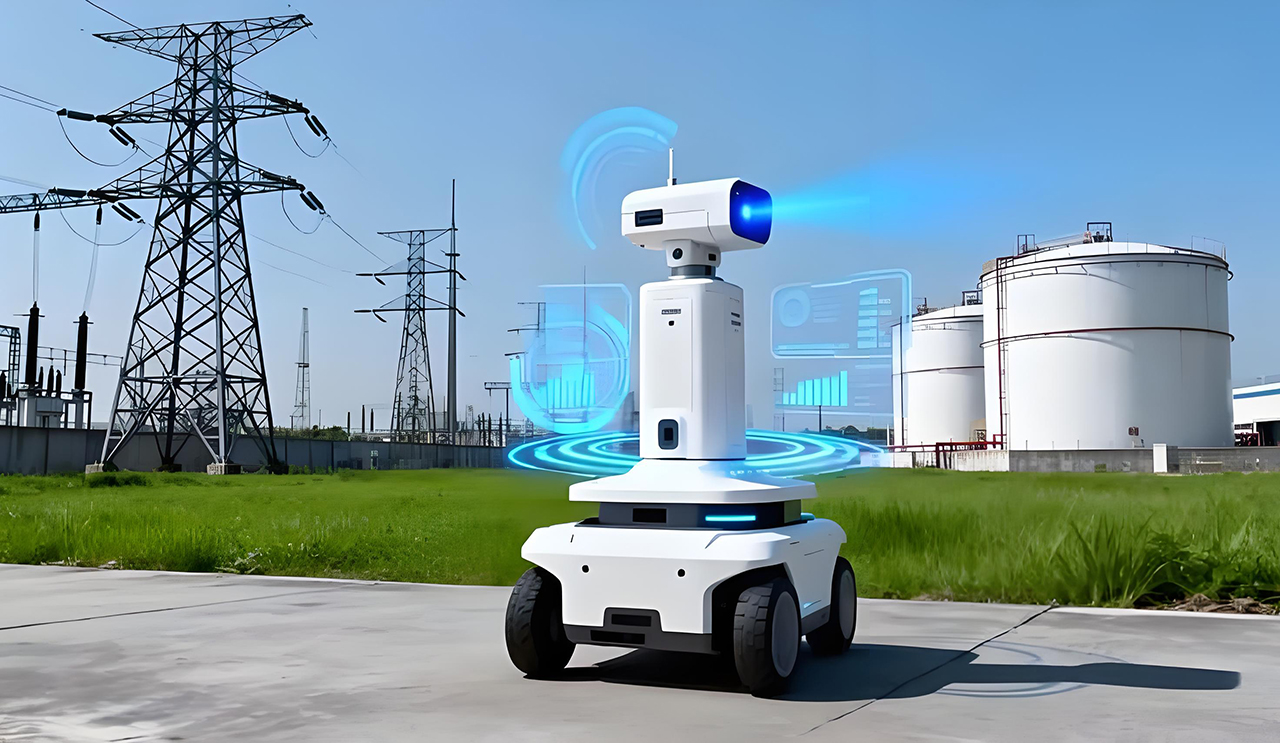
Many industrial scenarios such as inspection robots, explosion-proof AGV, mining mobile equipment, and chemical park inspection AMR have always relied on contact-based charging. The problems exposed during long-term operation are almost the same as those of lunar robots: In coal dust, grain processing, building material grinding, and chemical powder workshop environments, suspended dust is easily attached to the charging contacts. Repeated insertion and removal of the contacts cause not only rapid wear but also dust accumulation, which can lead to contact failure, overheating, and sparking; once an electric spark occurs, in explosive gas and dust environments, it will trigger major safety hazards.
These scenarios have several common characteristics:
① Complex environmental media, with flammable and explosive dust/gases;
② Equipment requires 7x24-hour unmanned inspection and operation, and it is unrealistic to conduct frequent manual maintenance of the charging mechanism;
③ Ground subsidence and material accumulation, the robot's navigation and positioning have errors, and it is difficult to achieve micrometer-level precise docking every time;
④ Customers prioritize safety level and the reliability of continuous operation of the equipment over charging speed.
In the past, many solutions in the industry simply enlarged the power of consumer-level wireless charging, only considering transmission efficiency, ignoring protection, anti-offset, and explosion-proof safety design in harsh conditions. The NASA project gives us a hint: Wireless charging in strict environments prioritizes safety and fault tolerance over extreme efficiency.
3. From deep-space solutions to industrial applications: 4 direct technical ideas that can be borrowed
1. Abandon contact dependence and eliminate ignition sources at the root
The root cause of the risk of contact charging is the electric arc generated at the moment of metal contact. Wireless induction charging has no physical contact and no plugging and unplugging actions, which eliminates the possibility of contact sparking structurally. Corresponding to the explosion-proof scenario, it is not enough to simply conduct explosion-proof certification for the outer shell of the wireless charging module; the entire circuit, magnetic coupling structure, and resonant control loop all need to be designed in an intrinsically safe manner. The NASA solution, to avoid the risk of leakage and short circuit caused by dust, adopts a fully enclosed integrated coupling structure. This idea is precisely the design direction for the wireless charging of explosion-proof robots: the coupling coils are fully sealed and encapsulated to prevent the invasion of dust and moisture, and no exposed conductive metal points are exposed.
2. Wide offset, dynamic power regulation, reducing the threshold for robot positioning
The lunar surface terrain is uneven, and the robot navigation has errors. It is impossible to precisely stop at the center of the charging point every time. Therefore, the solution supports stable power collection within a wide offset range, automatically dynamically matching the output power, and will not stop charging or reduce power due to offset. In the factory, this is of great significance: the dust workshop floor is prone to accumulation of materials and wear, and the navigation of the explosion-proof inspection robot itself has certain deviations. If wireless charging has extremely high positioning requirements, the actual implementation failure rate will increase significantly. The tolerant offset and anti-offset wireless charging solution, which is suitable for imperfect on-site conditions, reduces the downtime caused by positioning failure, and is also an important prerequisite for the successful implementation of opportunity charging.
3. Modular architecture, suitable for unmanned maintenance
The maintenance cost of deep-space equipment is extremely high. The design adopts a modular power unit, and a single module failure does not cause the entire system to collapse. It supports separate redundancy and replacement. The industrial special scenarios are also applicable: in chemical plants, mines, and explosion-proof parks, many areas do not allow personnel to enter for a long time. After the charging system is modularized, it can achieve remote status monitoring, fault isolation, and later maintenance does not need to frequently enter dangerous areas. The entire system can be linked with the robot scheduling system, automatically identifying power levels and autonomously replenishing power, and the entire process does not require manual intervention.
4. Strong environmental tolerance design, putting protection first
The lunar surface solution needs to withstand hundreds of degrees of temperature difference and continuous sandblasting. Translated to the industrial scenario, it means high IP protection level, corrosion resistance, and temperature resistance design. Many powder workshops, outdoor chemical parks, summer high temperatures, winter low temperatures, and corrosive gases, ordinary coils are prone to aging and resonance parameters drift. Referencing the material selection ideas of deep-space equipment, select magnetic materials and sealing materials that are resistant to aging and have low temperature drift to ensure that the transmission efficiency and coupling performance do not rapidly decline in a long-term harsh environment.
4. Rational perspective: Deep-space solutions ≠ direct copying, industrial implementation has its own trade-offs
We also need to objectively distinguish the differences between aerospace engineering and commercial industrial projects. The priority indicators of the NASA solution are reliability and safety, with weak cost constraints, and redundant designs are made without considering costs; while domestic industrial customers, in addition to safety indicators, also need to consider cost, delivery, charging efficiency, and renovation difficulty. Directly using aerospace-level components and redundant architectures as industrial products will be far beyond the market acceptance range. Therefore, the correct path for the industry is not to replicate aerospace products, but to absorb its design ideas and make industrial-level cost reduction adaptations: retain contactless, wide offset, fully sealed protection, and safety control logic, while meeting explosion-proof and dust environment specifications, and optimizing costs and improving mass production performance.
At the same time, it is also necessary to clarify the route differences: Currently, the mainstream IPT magnetic coupling wireless charging is more suitable for AGV, explosion-proof inspection robots, etc., which are of medium to high power and mobile equipment; while electric field coupling and other new technologies are more suitable for small and lightweight robots, and require more time for verification in high-power and high-protection scenarios.
5. Industry enlightenment: Special robots charging is entering a new demand trend
Domestic automation is gradually penetrating from ordinary warehousing to high-risk scenarios such as chemical processing, mining, powder processing, and oil and gas inspection. In the past, many projects were stuck at the charging stage: the risks of contact charging were high, maintenance was troublesome, and they became the bottleneck for the large-scale implementation of special robots. NASA's this wireless power supply project essentially confirms a trend: reliable, contactless, and highly fault-tolerant wireless power supply is the optimal energy replenishment route for unmanned mobile devices in harsh environments.
For automation integrators and complete machine manufacturers of special robots, choosing a wireless charging supplier is no longer just about comparing power and efficiency parameters; it is also necessary to focus on the explosion-proof design, sealing protection, anti-offset ability, and long-term environmental stability of the entire solution. The future market competition will no longer be about whose single module efficiency is higher, but who can provide a complete wireless energy replenishment solution that is compatible with dust, explosion-proof, unmanned值守 conditions, safe and controllable, and easy to implement.
The advanced deep-space exploration technology will eventually be applied to factory workshops. When robots on the moon and Mars travel autonomously with wireless power supply, the explosion-proof inspection robots in our workshops and AGVs in dusty environments will also rely on the same design concept to achieve truly safe, continuous, and unmanned autonomous operations.


 EN



 +86 18678901310







 Explosion-proof Wireless Charging