

WIRELESS CHARGING IN THE NEWS
The constraints of traditional wired charging and the inefficiency of energy management are becoming invisible shackles that prevent automotive manufacturing lines from moving towards higher levels of automation. As the "lifeblood" of modern automotive factories, the contradiction between AGVs' frequent charging demands and manual intervention has become increasingly prominent. Every 23 hours, they need to interrupt their tasks and drive to fixed charging piles, where they are plugged and unplugged by dedicated personnel. This not only depletes the charging interfaces but also directly results in a loss of equipment utilization and production rhythm.
Today, as we move towards Industry 4.0, Yutong Space-Time's industrial-grade high-power wireless charging solution is reshaping the energy replenishment mode of production lines for the world's leading automakers, initiating a silent revolution about "energy freedom".
Core pain point: Mobile productivity constrained by "lines"
In the welding and assembly workshops of the automotive manufacturing industry, AGV clusters are responsible for the just-In-time (JIT) delivery of heavy components such as engines, seats, and battery packs. Its pain points are far more than just the cumbersome process of plugging and unplugging
Continuous interruption: The production cycle is measured in seconds. The offline charging of AGVs means a temporary break in the logistics chain, affecting downstream workstations.
Safety hazard: The risk of electric sparks in workshops with flammable media cannot be ignored. Damp and oily environments pose challenges to the insulation of charging piles.
Management costs: Manual scheduling and maintenance of a large number of charging contacts generate hidden costs.
Rigid layout: Fixed charging piles limit the flexibility of production line transformation and AGV path optimization.
Solution: Composition of Parity spatio-temporal all-scenario wireless charging system
Yucheng Space-Time does not offer a single device to the automotive manufacturing industry, but rather a "perception, transmission and management" energy closed-loop system deeply integrated into the production system.
1. Ground transmitter (Tx) : It adopts a high-strength aluminum alloy housing and an IP67 protection grade, and can be directly embedded and installed at the common parking points and waiting areas of AGVs. The core of it is a specially designed transmitting coil with a magnetic circuit, combined with the company's self-developed high-frequency inverter and resonant compensation topology, to achieve efficient energy transmission.
2. On-board Receiving end (Rx) : Highly integrated and flat design, it can be integrated into various AGV chassis without loss. Equipped with multiple safety mechanisms such as foreign object detection (FOD), metal overheat protection, and live body protection, it ensures absolute reliability in complex industrial environments.
3. Intelligent communication and control system: Seamlessly integrated with the AGV upper computer and the factory MES/WMS system via CAN/ Ethernet. The system can monitor the battery status in real time, and based on the priority of production tasks, intelligently decide on the best charging time and duration (opportunistic charging), achieving fully automatic energy dispatching.
Workflow: When the AGV equipped with the parity spatio-temporal receiving end enters the charging area, the system automatically aligns through magnetic coupling resonance, verifies the identity, and initiates safe high-power power transmission. The entire process is undisturbed. Agvs can complete "fast energy charging" during the intervals of material loading and unloading or brief waiting, truly achieving "stop and charge immediately, go and use immediately".
Revolutionary advantage: From "Necessary downtime" to "Productivity release"
7x24-hour continuous operation: Eliminating unplanned downtime, the overall equipment utilization rate (OEE) can be increased by up to 30%.
2. Ultimate safety and durability: Fully sealed and contactless charging fundamentally eliminates electric sparks, causes no physical wear and tear, and is suitable for extreme environments such as high dust (like welding areas) and humidity (pre-treatment in painting workshops).
3. Maximizing production flexibility: Charging points can be flexibly adjusted according to the production line layout, supporting rapid production line switching, laying the foundation for flexible manufacturing in future factories.
4. Intelligent energy management: Charging data is integrated into the factory's digital twin system, providing crucial data support for lean production and energy consumption optimization.
The wireless charging system of Yucheng Space-time has been stably operating in the smart factories of many mainstream domestic automakers for over a million hours. It is not merely a replacement for charging technology, but a key infrastructure driving the evolution of the automotive manufacturing industry's logistics system towards full automation, high flexibility and intelligence. When every mobile unit on the production line gains "energy freedom", the potential of the entire manufacturing system is truly activated.


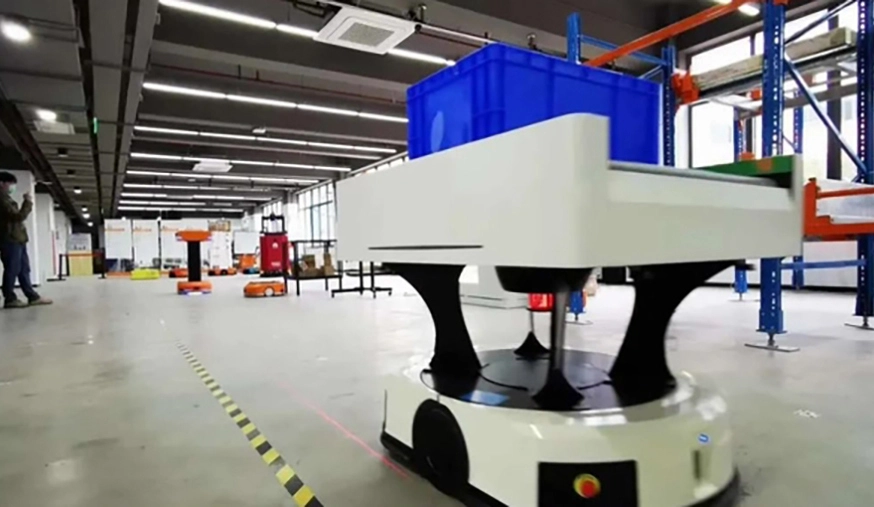

 AGV/AMR Manufacturing Wireless Charging Solution
Inspection Robot Wireless Charging Solution
Mining Explosion-proof Wireless Charging Solution
Service Robot Wireless Charging Solution
Photovoltaic Robot Wireless Charging Solution
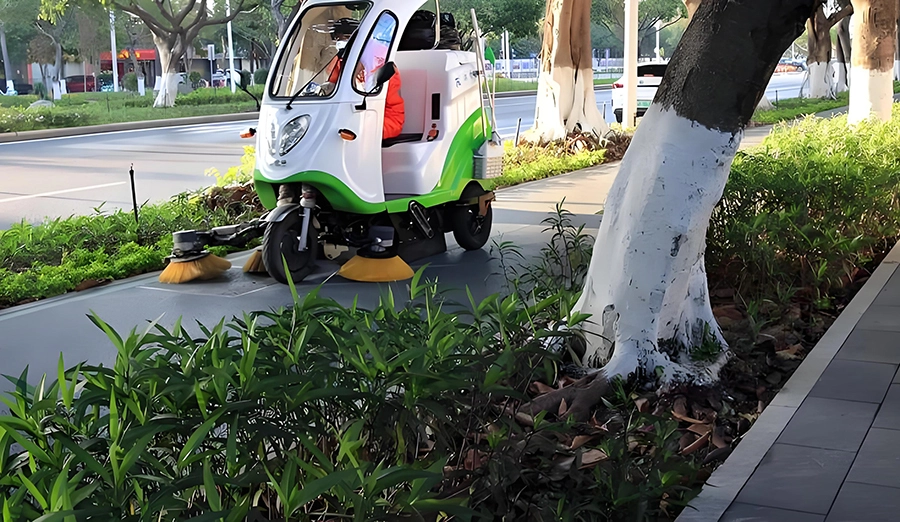
Outdoor Cleaning Robot Wireless Charging Solution
 Contact: Ms. Yang
 +86 18678901310
 luyu@wireless-power.com.cn
 801, 8th Floor, Building 1, Huizhiyuan, 117 Huizhiqiao Road, High-tech Zone, Qingdao,China
 WECHAT





 EN
EN

 +86 18678901310