

WIRELESS CHARGING IN THE NEWS
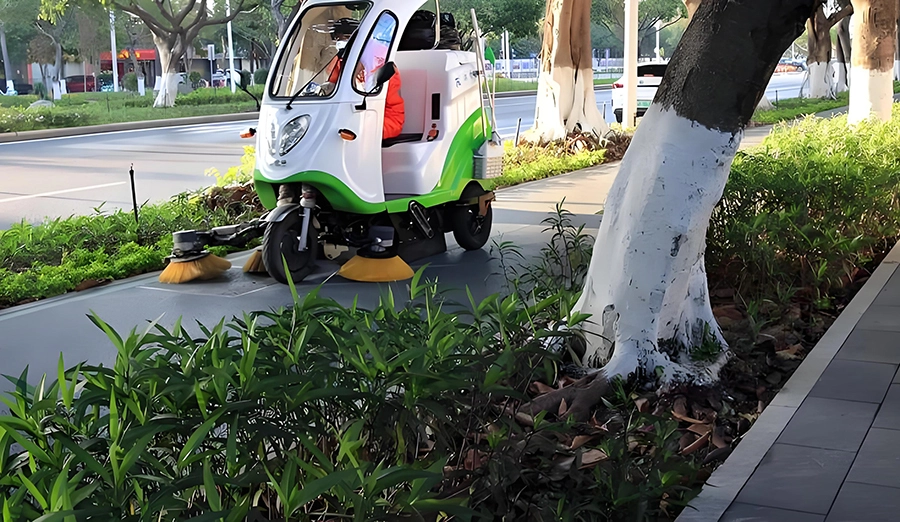
When unmanned cleaning vehicles move from demonstration projects to large-scale deployment, the key to their commercial success has shifted from technical feasibility to operational economy. The traditional energy replenishment model, due to its inherent labor, efficiency, maintenance and opportunity costs, often leads fleet operations into a vicious circle of "diseconomies of scale". WIRELESSPT's wireless charging solution is transforming unmanned sanitation fleets from a "cost center" that requires continuous investment to a highly efficient and data-intelligent "benefit engine" by reconfiguring the entire energy supply process.
The "iceberg" of hidden costs in traditional charging modes
Beneath the water surface, undercalculated costs are eroding project returns:
Direct labor costs: Wages, benefits and management expenses of full-time charging staff. The larger the fleet, the more linearly this cost increases.
Idle equipment cost: The charging time (usually 24 hours) and the time spent traveling to and from the charging station result in the overall equipment utilization rate (OEE) generally being lower than 70%. This means that nearly one-third of asset investments are idle for most of the day.
Maintenance and consumables costs: Regular replacement costs for charging interfaces and cables, repair costs for vehicle electronic control system damage caused by poor contact, and maintenance costs for outdoor charging piles themselves.
Opportunity cost: As the equipment needs to be charged during the day, it is unable to undertake immediate tasks such as midday cleaning and handling sudden pollution, thus losing the opportunity to generate additional income or improve service levels.
Managing complexity costs: Dispatchers need to spend a great deal of energy coordinating charging and tasks, planning routes, and handling unplanned disruptions caused by charging.
WIRELESSPT solution: Driving economic model optimization with "fully automatic and efficient energy replenishment"
Our system directly resolves the above-mentioned cost pain points through technological penetration
Enhancing Asset Utilization Rate (OEE) - Transforming "Idle" into "Output Value"
Opportunity charging mode: During breaks in the operation of the sweeper (such as waiting for garbage to be dumped, briefly avoiding pedestrians), during task transitions, or during periods of low electricity prices, guide it to the nearest wireless charging point for "fast energy charging" (a considerable amount of power can be replenishment within 10 to 30 minutes). This enables the average daily effective operation time of vehicles to increase by over 90%, and for fleets of the same scale, the coverage area can be expanded by 30%, or the number of vehicles required to complete tasks of the same area can be reduced, directly diluting the depreciation cost per vehicle and enhancing marginal returns.
Reduce direct and indirect operating costs
Zero manual intervention: Fully automatic charging eliminates the need for dedicated personnel, and related costs are directly reduced to zero. Managers can monitor the overall situation through the platform.
Zero maintenance cost: Fully enclosed contactless design eliminates the biggest source of failure - physical connectors. The system's mean time between failures (MTBF) is extremely long, and the maintenance requirements are very low.
Reducing energy costs: The smart energy management platform can automatically set main charging during off-peak hours of the power grid, taking advantage of the price difference to save electricity bills. In the long run, this is a considerable savings.
Opening up New Value Increments - From "Execution Tools" to "Data Nodes"
Each sweeper equipped with wireless charging converts every charging behavior into precise data: charging time, geographical location, energy consumption, and battery health status. These data, when aggregated to WIRELESSPT's cloud analysis platform, will generate value beyond charging itself:
1. Refined operation accounting: It can accurately calculate the energy consumption cost of cleaning operations for each street and each park, providing a basis for precise pricing and assessment of public service procurement.
2. Battery asset health management: By analyzing charging curves and battery degradation data, predict battery life, optimize battery replacement plans, and maximize asset value.
3. Grid Coordination and Load Forecasting: As a dispatchable flexible load, the fleet can provide an interface for future integration with grid demand response (DR) projects, reducing charging power during peak grid hours and possibly even obtaining additional compensation.
Calculate the economic account clearly: The return on investment is clearly visible
Suppose there is a project with 20 unmanned cleaning vehicles:
The traditional model: Annual operating costs may include the salaries of several charging personnel, high equipment idleness losses, and continuous maintenance expenses.
WIRELESSPT wireless charging mode: Although there is an initial investment in equipment, it can increase vehicle utilization to replace the purchase of additional vehicles, save all charging manpower, significantly reduce maintenance costs, and save the price difference of off-peak electricity. From then on, positive cash flow brought about by "cost savings" will continue to be generated.
The wireless charging solution of WIRELESSPT is far more valuable than just "charging". It is a productivity transformation tool that fundamentally reshapes the economic formula of unmanned sanitation fleets by freeing up time, reducing waste, and mining data value. It makes every cleaning operation more efficient and every investment more valuable, truly driving the smart sanitation industry from "operational" to "highly profitable", and from experimental scenarios to a sustainable and large-scale future.



 AGV/AMR Manufacturing Wireless Charging Solution
Inspection Robot Wireless Charging Solution
Mining Explosion-proof Wireless Charging Solution
Service Robot Wireless Charging Solution
Photovoltaic Robot Wireless Charging Solution
Outdoor Cleaning Robot Wireless Charging Solution
 Contact: Ms. Yang
 +86 18678901310
 luyu@wireless-power.com.cn
 801, 8th Floor, Building 1, Huizhiyuan, 117 Huizhiqiao Road, High-tech Zone, Qingdao,China
 WECHAT





 EN
EN

 +86 18678901310