

WIRELESS CHARGING IN THE NEWS
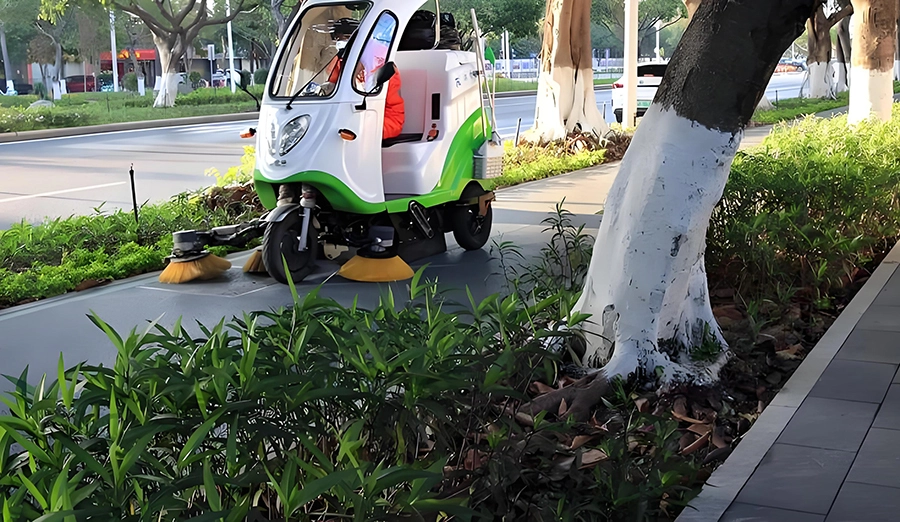
In the grand blueprint of smart sanitation, safety and reliability are the unshakable cornerstones. Unmanned cleaning vehicles are exposed to complex public environments for a long time. The safety of their energy supply methods and the reliability of the equipment itself are directly related to public safety, urban image and operating costs. The risks and management burdens that traditional plug-in charging poses in outdoor scenarios are rapidly amplifying with the large-scale application of such devices. WIRELESSPT's wireless charging solution, with the core concept of "zero contact", is fundamentally strengthening the safety defense line for outdoor unmanned sanitation equipment and resolving management chronic problems.
The "Triple Risks" and "Two Major Burdens" of outdoor wired charging
Electrical safety risk: The interfaces of charging piles in public areas (such as parks and walkways) may cause electric shock if touched by curious people (especially children). Charging on rainy days poses a risk of electric leakage. Aging interfaces and sparking may cause fires in dry seasons.
2. Equipment operation risks: Frequent mechanical plugging and unplugging can cause physical wear and deformation of the interface, resulting in increased contact resistance, abnormal heating during charging, and in severe cases, burning out the vehicle or the controller of the charging pile. Sand and deicing agents corroded the terminals, causing false signal alarms and charging failures.
3. Public and management risks: Exposed cables may trip pedestrians; Charging piles occupy public space and affect the city's appearance. Managers need to regularly inspect the interface status, clean up dust and debris, and carry out preventive replacements. The maintenance work is rather complicated.
4. Asset management burden: Connectors have a limited lifespan and are classified as high-frequency consumables. The larger the fleet size, the higher the spare parts inventory and replacement costs. Vehicle breakdowns caused by charging interface failures can lead to mission delays and emergency repair costs.
5. Operational scheduling burden: It is necessary to assign dedicated personnel to be responsible for charging at specific times, and human resources cannot be flexibly scheduled. The charging period is fixed, and it is impossible to take advantage of the off-peak electricity price to save on electricity bills.
The "fully enclosed fortress" safety design of WIRELESSPT
Our wireless charging system has restructured the safety boundary from a physical principle:
Intrinsic safety, eliminating risk sources: Energy is transmitted through a completely sealed shell made of high-strength engineering plastic and aluminum alloy, with no electrical exposure between the transmitting and receiving ends. Even in heavy rain, there is no risk of electrification on the surface of the charging area, truly achieving "wading charging".
Industrial-grade environmental durability: The transmitting base station has an IP67 protection rating and excellent corrosion resistance, capable of withstanding high-pressure water gun flushing, salt spray erosion and ultraviolet radiation for a long time. The on-board receiving end has undergone rigorous vibration and shock tests to ensure it has the same lifespan as the vehicle.
Multi-layer active safety protection net
Foreign Object Detection (FOD) : Continuously monitor whether there are metal foreign objects (such as coins, keys) between the charging interfaces to prevent eddy current heating.
Live protection: Utilizing multi-sensor fusion technology, once a small animal or part of the human body is detected to intrude into the energy area, the power is instantly cut off.
All-round status monitoring: Real-time monitoring of temperature, voltage, current and offset. Any abnormal parameter will immediately enter the protection state.
System Integration and intelligent Management: Transforming Passivity into Initiative
This system is deeply integrated into the intelligent environmental sanitation management platform
1. Unmanned automatic execution: The vehicle independently completes the entire process of parking, charging, and continuing tasks. Managers only monitor the status and energy efficiency reports on the large screen in the background.
2. Predictive maintenance: The system continuously analyzes data such as charging efficiency and temperature rise curves, and issues early warnings for potential faults (such as a decline in the performance of cooling fans), transforming "repair after failure" into "planned maintenance".
3. Refined cost control: The platform can set strategies to prioritize charging vehicles during the off-peak electricity price periods at night, significantly reducing long-term electricity bills.
The core values of creation: safety, peace of mind and cost reduction
1. Public safety level upgrade: Completely eliminating electrical safety hazards in outdoor public places, making technological sanitation warmer and more reassuring.
2. Greatly simplified operation management: Achieve "maintenance-free" charging, liberating managers from the cumbersome tasks of inspection, plugging and unplugging, and replacement, allowing them to focus on higher-value scheduling and optimization tasks.
3. The total cost of ownership (TCO) has significantly decreased: The extremely high reliability has greatly reduced the costs of downtime and maintenance due to failures. There are no contact wear parts, eliminating the cost of periodic replacement of consumables. Smart off-peak electricity charging saves energy costs.
4. Smart enhancement of urban image: Clean and tidy charging stations without messy cables are highly consistent with the image of modern smart cities, highlighting the technological content and refined level of management.
The wireless charging solution of WIRELESSPT offers unmanned cleaning vehicles not only a charging method but also a brand-new standard for safe, reliable and efficient operation. It enables urban managers to deploy more unmanned devices with peace of mind, reducing manpower and risks while enhancing the quality and resilience of sanitation services, quietly and firmly safeguarding every inch of the city's cleanliness.



 AGV/AMR Manufacturing Wireless Charging Solution
Inspection Robot Wireless Charging Solution
Mining Explosion-proof Wireless Charging Solution
Service Robot Wireless Charging Solution
Photovoltaic Robot Wireless Charging Solution
Outdoor Cleaning Robot Wireless Charging Solution
 Contact: Ms. Yang
 +86 18678901310
 luyu@wireless-power.com.cn
 801, 8th Floor, Building 1, Huizhiyuan, 117 Huizhiqiao Road, High-tech Zone, Qingdao,China
 WECHAT





 EN
EN

 +86 18678901310